.png)
What to Order If You've Never Had Greek Food Before

If someone says Greek food and the first thing that comes to mind is a gyros, you are not wrong, but you are also only seeing a small corner of a much bigger picture.
Gyros, the meat carved off a spit and wrapped in pitta, is genuinely Greek and genuinely good when done properly. But it is street food, the equivalent of judging Italian cooking entirely on a slice of pizza from a takeaway counter. It tells you something true about Greek food, that it is built to be eaten quickly, shared easily, and enjoyed without ceremony, but it does not tell you much about what actually happens at a Greek table.
A Greek table looks different. It is built around freshness, and around a lot of small things rather than one big thing. There is almost always a salad. There are almost always olives. There is bread, there is something grilled, there is something stewed, and there is usually cheese in more than one form. Nobody orders a single dish and eats it alone. The table fills gradually, and everyone eats from everything.

The good news is that you have probably had more Greek food than you think. Filled pastry, the kind with cheese or spinach wrapped in thin, crisp layers, is deeply traditional. Grilled skewers of marinated meat are everywhere in Greek cooking. If you have ever eaten either of those things and enjoyed them, you already know more about Greek food than the gyros comparison suggests.
This is a guide to what to actually order if you are coming to Nectar and Greek food is new to you, or if you want to understand what you are looking at the next time you do.
The classic order
If someone asks me what to get on a first visit, there is a combination I come back to more than any other, and it covers most of what makes Greek food what it is.
Start with the cheese filo pastry. This is the dish that does the most work in terms of introducing someone to Greek food, because it sits at the meeting point of savoury and sweet that runs through so much of the cuisine. Crisp filo, melted cheese, honey, sesame. If you have never had anything like it, the combination sounds unusual on paper and makes complete sense the moment it arrives.
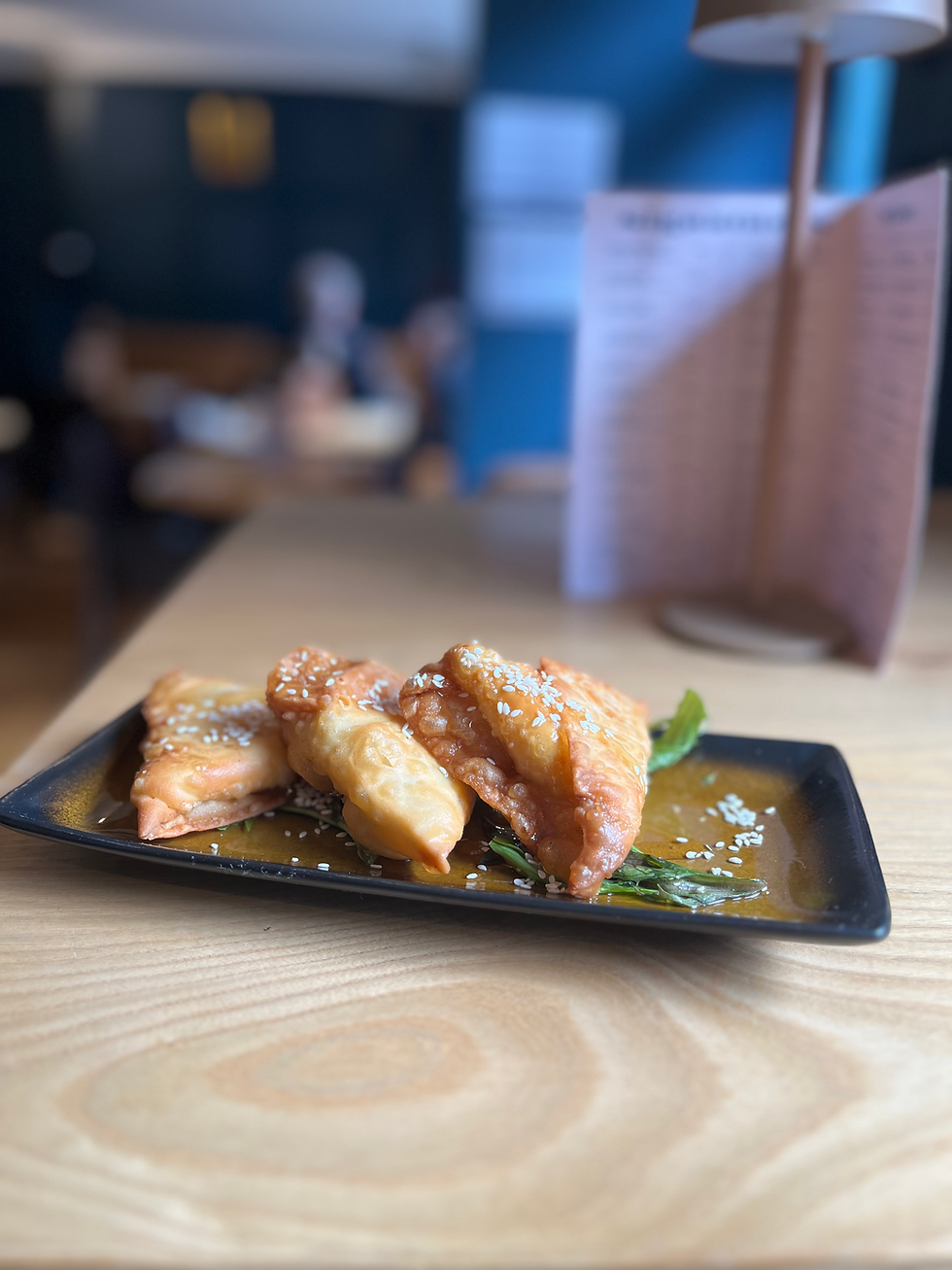
Alongside it, the vegetable stew from the vegetable sides. This is the dish that most surprises people, because it does not look like much and then tastes like considerably more than its appearance suggests. Slow-cooked vegetables, olive oil, herbs, the kind of dish that takes time and produces depth rather than spectacle. It is also the dish that best represents the freshness-first philosophy that runs through Greek cooking: nothing is disguising anything else, the vegetables taste like vegetables, just considered and cooked properly.
Then the chicken skewer. Non-negotiable. This is our bestseller and it is the dish that most directly answers the grilled skewer point above: marinated, grilled over direct heat, simple in construction and exacting in execution. If Greek cooking has a signature technique, it is this one, and the chicken skewer is the cleanest demonstration of it on the menu.

And then something from the sea. Either the sea bass or the prawns in tomato sauce. Greece is a country surrounded by water on most sides, and seafood is not a special-occasion category in Greek cooking the way it sometimes is elsewhere. It is simply part of the table. Both of these dishes are genuinely beautiful and both reward a try, even from people who think they know whether they like fish or not.
That is four dishes, and for two people that is a proper introduction to what Greek food actually is.
Why ordering more, smaller things is the right approach
The instinct for a lot of people who have not done this before is to order one platter and treat it as the meal. I understand the instinct, a platter looks like a complete answer, but I think it is the wrong one, and it is worth explaining why.
A platter is a good way to get a lot of things at once, but it flattens the experience. Everything arrives together, on one board, and the meal becomes about working through a fixed selection rather than building one. The platters are genuinely excellent and there is a reason they are one of the most ordered things on the menu, but they are the right choice for a specific kind of evening: a group, low on decisions, want to be looked after.
For a first encounter with Greek food specifically, I think ordering several individual dishes is better, because it mirrors how the food is actually meant to be eaten. Things arrive across the evening rather than all at once. You try something, you talk about it, you decide what comes next based on what you just had. The meal has a shape to it. A platter removes that shape in exchange for convenience, and for someone who is trying to understand what this food is rather than just eat dinner, the shape is worth having.
The things that might surprise you
A few details worth knowing before you sit down, because they are small but they change how you read the table.
The olives will probably not be the green olives you are used to seeing on a pizza or in a martini. Kalamata olives are dark, almost black, and they are picked later and cured for longer than green olives. The result is a deeper, richer, more fruit-forward olive, less sharp and one-note than a green olive, with more going on. If your experience of olives is limited to the green ones, Kalamata is worth tasting on its own terms. They turn up across Greek cooking constantly, in salads, alongside cheese, on their own with a drink, and they taste like a different fruit entirely to what most people expect from the word olive.
If you are looking for chips, you will not find them. What you will find instead is zucchini fries, courgette cut into batons, lightly battered or coated, and fried until crisp. This is a genuinely traditional Greek dish rather than a modern substitution, and it does the job that fries do, something crisp and moreish alongside everything else, while tasting distinctly of what it actually is.
And if grilled cheese is what you are after, halloumi is the answer, though it comes from Cyprus rather than mainland Greece specifically. It is one of our bestsellers and one of the easiest entry points into the whole menu: a cheese that holds its shape under heat, develops a golden crust, and has a savoury, slightly squeaky quality that is genuinely unlike most other cheeses people have tried. If you are nervous about anything else on this list, halloumi is the safe, completely reliable place to start, and it will not be the last time you order it.
The bigger picture
None of this is complicated, and that is sort of the point. Greek food is not trying to impress you with technique you cannot see or flavours that need explaining before you taste them. It is built on good ingredients, treated simply, and put on the table together so that the meal becomes something shared rather than something each person works through alone.
If you have never had Greek food before, or if you have only had the version that comes wrapped in pitta from a late-night counter, the table at Nectar is a different starting point. Cheese filo pastry, the vegetable stew, the chicken skewer, something from the sea. Order those four to start, see what the table looks like once they arrive, and decide what comes next from there.
What to drink alongside it
Greek food and Greek drink were never really designed to be separate decisions, and if this is your first time at the table, it is worth thinking about what is in your glass as part of the same introduction.
If you want a cocktail that sits naturally alongside this kind of food without overpowering it, the Drops of the River is the one I would point you toward. It is botanical and floral rather than heavy, built around gin, mastiha, and elderflower, and it has enough lightness to sit alongside the cheese filo pastry and the vegetable stew without competing with either. It is also, in its own way, a good introduction to mastiha, the resin-based Greek liqueur that turns up across the menu and that very few people outside Greece have ever knowingly tasted.

Wine is the other half of this, and it is worth knowing that Greek wine has very little to do with what most people picture when they think of wine from a warm Mediterranean country. The Assyrtiko, a white from Santorini, is bone dry, high in acidity, and almost mineral in character. It is the wine I would put alongside the sea bass or the prawns specifically, because that combination of acidity and precision does for fish what a squeeze of lemon does, except built into the glass rather than added at the table. If you are ordering something from the sea, this is the pairing.
For the chicken skewer, or if your table is leaning more toward the meat side of the order, the Xinomavro is worth trying. It is Greece's most serious red grape, structured and aromatic in a way that genuinely surprises people who assume Greek red wine will be light or simple. Alongside grilled meat, it has the tannin and the depth to hold its own.

Neither of these wines needs to be a big decision. If you are not sure, tell us what you have ordered and we will point you toward the glass that goes with it. But if this is genuinely your first time with Greek food, trying a Greek wine alongside it is part of the same experience, and it is one more thing on this list that is probably more approachable than you expect.
Book a table at Nectar Bar and let us know it is your first time with Greek food. We will steer you right.


