.png)
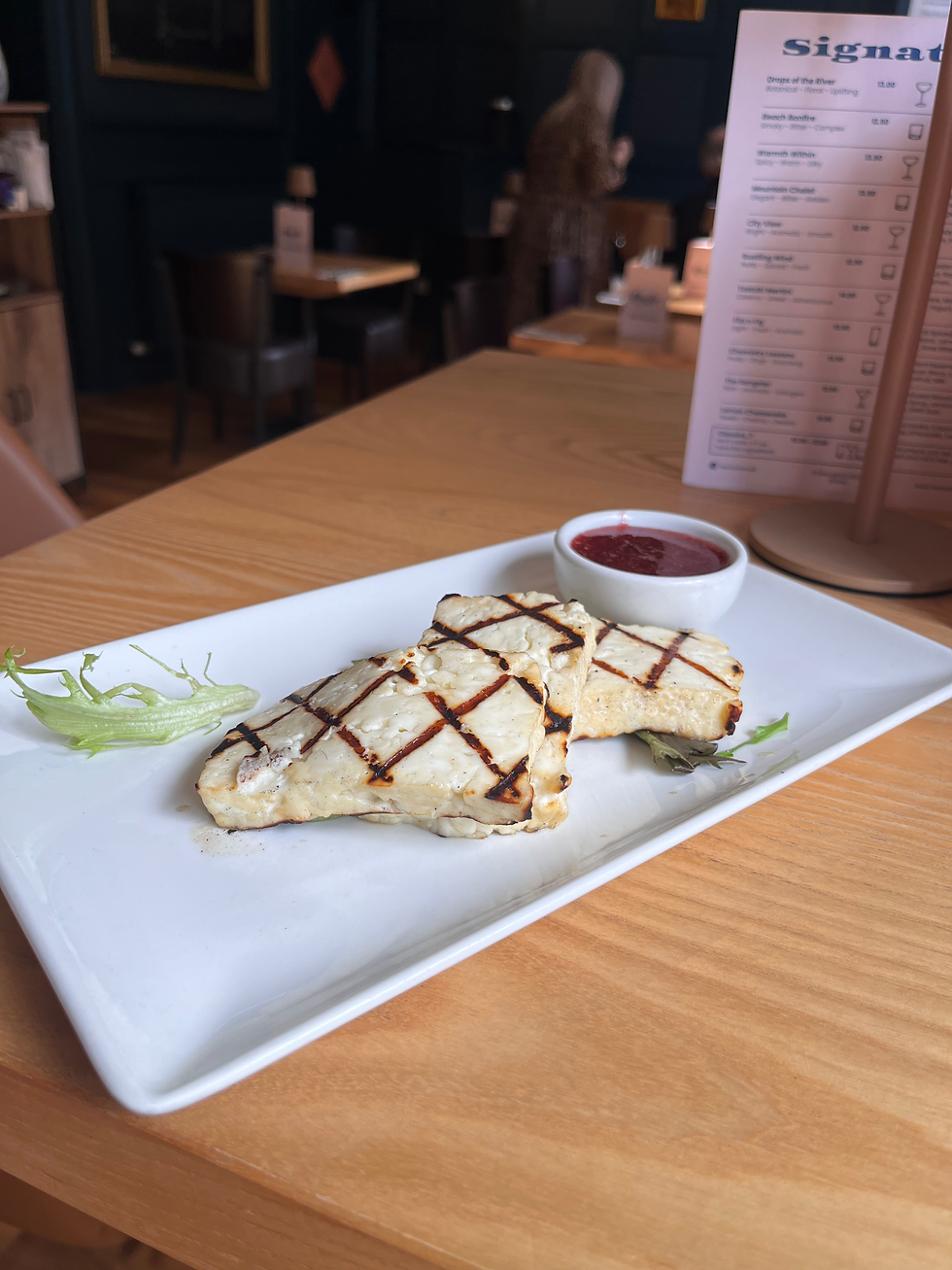
Grilled Halloumi with Dark Forest Fruit Chutney

If you have ever bitten into a piece of cold halloumi and felt that curious, almost musical squeak against your teeth, you already know that this is not a normal cheese. It announces itself differently. It behaves differently. And when it is grilled and served hot, it transforms into something that is very difficult to stop eating.
Halloumi is one of my favourite things on the Nectar menu, and I say that as someone who has eaten more of it than is probably reasonable. There is something deeply satisfying about a dish this simple that also has this much going on. A golden crust. A soft, yielding interior. The salt, the warmth, the slight caramelisation that happens in those final moments on the grill. Paired with the right things, it is one of those dishes that makes a table feel complete.
But before we get to how we serve it, it is worth understanding what halloumi actually is, because the story behind it is as interesting as the cheese itself.

A cheese with centuries behind it
Halloumi comes from Cyprus, and its roots go back further than most people realise. The earliest written records of its production date to the Byzantine period, which means Cypriots have been making and eating this cheese for well over a thousand years. It has always been a practical, working ingredient: something that could be preserved, transported, and cooked over an open fire without dissolving into the embers.
Traditionally, halloumi is made from a mixture of sheep's and goat's milk. The sheep's milk brings richness and a deeper, more complex flavour. The goat's milk adds a subtle sharpness and a cleaner finish. The balance between the two is part of what gives authentic Cypriot halloumi its distinctive character. Many commercial versions today use a proportion of cow's milk as well, which produces a milder, more neutral flavour, but the traditional recipe remains sheep and goat.
In 2021, the European Union granted halloumi Protected Designation of Origin status, which means that to carry the full PDO certification, it must be produced in Cyprus to specific standards. This was a significant moment for Cypriot producers and a recognition of just how culturally important this cheese is to the island.
The science behind the squeak
That squeaking sound is one of halloumi's most distinctive and endearing qualities, and it comes down to the way the cheese is made.
During production, the halloumi curds are heated twice, a process that changes the protein structure in a way that is unlike most other cheeses. The proteins in halloumi align into long, elastic strands. When you bite into cold halloumi, those strands rub against the enamel of your teeth and produce the squeak. It is not a sign of anything wrong with the cheese. It is just physics. And for many people, it is part of the pleasure.
This same protein structure is responsible for halloumi's other famous quality: its unusually high melting point. Most cheeses become liquid when exposed to direct heat. Halloumi does not. You can place it directly on a grill or into a hot dry pan and it holds its shape, develops colour on the surface, and warms all the way through without losing its form. This is what makes it so useful and so delicious as a cooked ingredient.
When it comes off the heat and arrives at your table still warm, something entirely different happens compared to eating it cold. The interior becomes soft and almost creamy. The salt mellows and a gentle natural sweetness comes through. The squeakiness gives way to a texture that is tender and yielding, with that golden crust providing just enough resistance to make each bite feel complete.
It is the same cheese. The same ingredient. But heat transforms it.
Why the dark forest fruit chutney matters
At Nectar, we serve our grilled halloumi with a dark forest fruit chutney, and the combination is one of those pairings that makes complete sense the moment you try it.
Halloumi is rich and salty and satisfying. It carries a lot of flavour and a lot of density. The chutney brings two things that the cheese does not have on its own: sweetness and acidity. The fruit sweetness softens the salt and creates a contrast that keeps every bite interesting. The gentle acidity lifts the whole dish and stops the richness from sitting too heavily.
This interplay between savoury and sweet is one of the things Mediterranean food does better than almost any other culinary tradition. It is not about one flavour dominating. It is about creating a conversation on the plate where each element makes the other more interesting. The chutney makes the halloumi taste more like itself, if that makes sense. It gives you a reference point that sharpens everything.
There is also something lovely about the way the dark fruit notes in the chutney echo the caramelisation on the surface of the cheese. The grill develops a depth and a slight bittersweet quality in the crust, and the forest fruits pick that up and carry it through the whole dish.
The role of Grilled Halloumi in Mediterranean cooking
Across the eastern Mediterranean, halloumi has always played a central role in the way people eat. In Cyprus it is eaten at every stage of a meal: breakfast, grilled alongside eggs and tomatoes in the morning; as part of a meze spread in the afternoon; as a main event in the evening. It is not treated as a side dish or an afterthought. It is a proper ingredient that anchors a table.
This is how we think about it at Nectar too. The halloumi is a dish in its own right, not a supporting act. It works as a standalone plate when you want something focused and not too heavy, and it works equally well as part of a broader sharing table.
If you are building a larger spread, you will also find halloumi as part of our Veggie Platter, which brings together several of Margarita's favourite Mediterranean plates. Whether you order it on its own or as part of the platter depends on how hungry you are and how many other dishes are coming. But either way, the honest recommendation is to eat it the moment it arrives. Halloumi is at its best straight off the grill, while the interior is still soft and the outside still has its warmth and its crust.
The connection to Margarita's kitchen
Margarita grew up cooking Greek and Mediterranean food, and her approach to the menu at Nectar reflects a lifetime of understanding how these ingredients should be handled. Before Nectar, she spent years in Edinburgh's Mediterranean kitchens, including time as sous chef at Fava, which remains one of the most respected Greek restaurants in the city. That background informs everything that comes out of our kitchen.
With halloumi specifically, the principle is the same as it is with every dish: respect the ingredient, understand what it is capable of, and give it what it needs to be the best version of itself. Halloumi does not need to be complicated. It needs the right heat, the right timing, and the right thing alongside it. The dark forest fruit chutney is that thing.
What to drink alongside it
The pairing question with halloumi is genuinely interesting because the dish moves across two flavour registers simultaneously. The saltiness of the cheese pulls in one direction. The sweetness of the chutney pulls in another. Whatever you are drinking needs to work across both.
On the wine side, our Montepulciano is where I would start. It is a central Italian red from the Abruzzo region, made from the Montepulciano grape, and it brings exactly the right qualities to this pairing. Fuller body, dark fruit character, soft tannins, and a gentle earthiness that sits naturally alongside rich, salty food. The body means it does not disappear next to the density of the cheese. The dark fruit echoes the chutney. And the structure holds through the saltiness without becoming harsh or tannic. It is one of those pairings where both the food and the wine taste better together than they do apart.
If cocktails are where the evening is heading, the Mountain Chalet is the combination I find most satisfying alongside halloumi. Woodford Reserve bourbon, Aperol, Martini Rosso, and an orange foam. The warmth and depth of the bourbon sits alongside the richness of the cheese rather than competing with it. The citrus in the foam does the same job as the acidity in the chutney, lifting and brightening without overpowering. And the subtle sweetness from the Aperol ties back into the fruit notes on the plate. Everything is pulling in a complementary direction.
A dish that earns its place
There are dishes on a menu that exist because they are expected. And there are dishes that exist because they are genuinely, consistently good and people keep ordering them.
Our halloumi is the second kind. It is one of those things that comes back to the table again and again, ordered by people who have had it before and want it again, and by people who are trying it for the first time and immediately understand why it keeps getting ordered.
It is not a complicated dish. It is a very good version of a simple thing. And sometimes that is exactly what a table needs.
Book a table at Nectar Bar and order the halloumi while it is hot.
Opening hours Tuesday to Thursday: 5pm to 11pm Friday: 5pm to 1am Saturday: 12pm to 1am Sunday: 12pm to 11pm Monday: Closed
Nectar Bar, 73 Broughton Street, Edinburgh EH1 3RJ


