.png)
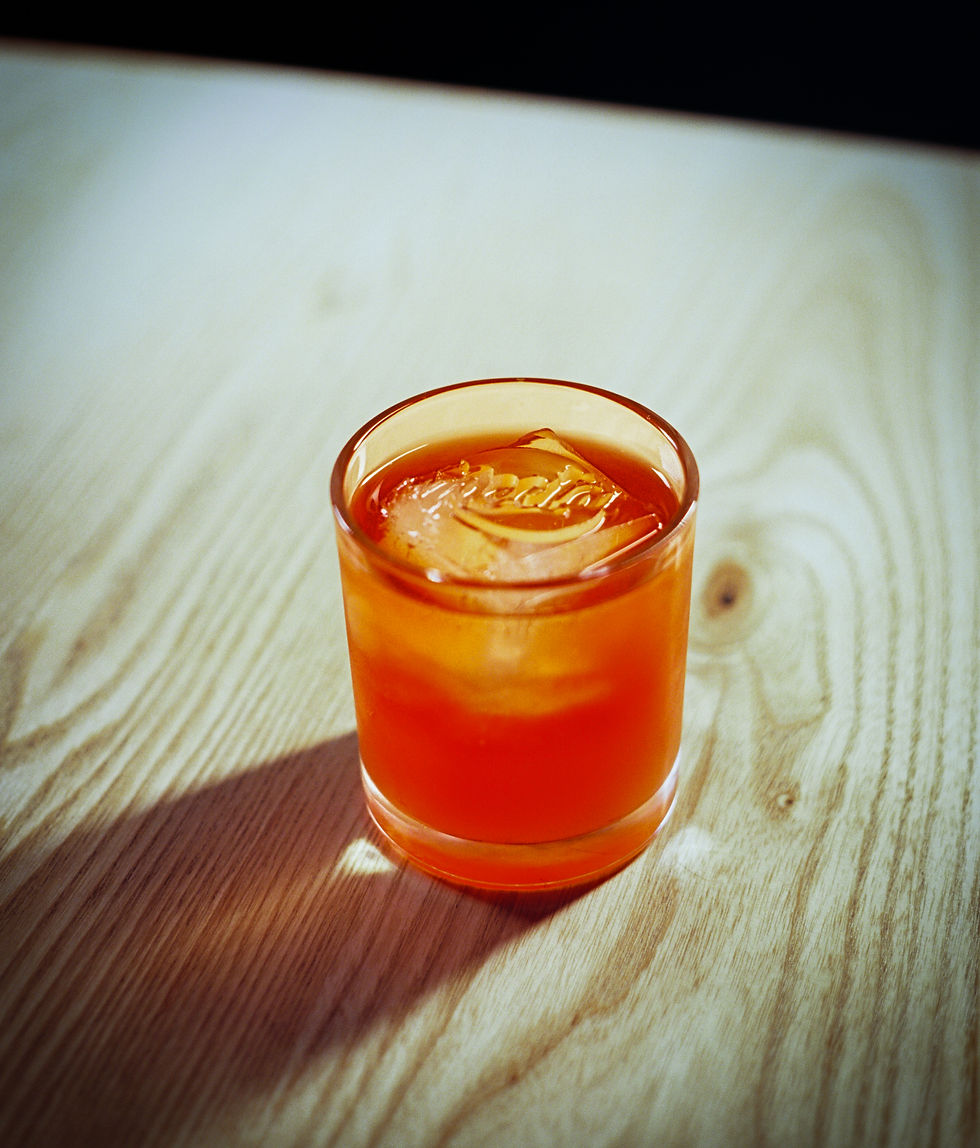
Mountain Chalet. Elegant. Bitter. Golden.

Some cocktails are created purely for flavour. Others are created because a conversation at the bar raises a question that refuses to go away.
Mountain Chalet began with a question about garnish. Not a complicated question, but the kind that, once asked, changes how you think about every drink you build afterwards.

The Visit That Started It
Shortly after Nectar opened, Panos and I went to visit Panda and Sons on Queen Street.
If you are not familiar with Panda and Sons, they are one of the most recognised cocktail bars in the world. They have been named the number one bar in the World's Top 500 Bars list and have placed consistently in the World's 50 Best Bars rankings. We wrote about them in our guide to the best cocktail bars in Edinburgh for good reason. Their technical precision is on another level, and going there with fresh eyes, as someone who had just opened their own cocktail bar, was a genuinely educational experience.
One moment from that visit stayed with me longer than anything else.
With one of the drinks, they served a piece of dehydrated ice cream as a garnish. The flavour it added was extraordinary. For a moment I found myself focusing entirely on the garnish rather than the cocktail beneath it, which is not something that usually happens. The garnish had become part of the drink in a way that a lime wedge or an orange peel never manages.
When I came back to Nectar I told Panos what I had experienced and suggested we start experimenting with something similar.
His response has shaped how we build cocktails ever since.
Panos's Rule
Panos listened, thought about it, and said something that was simple enough to sound obvious but is actually quite difficult to execute consistently.
A great cocktail should never rely on a garnish to be interesting. The garnish should enhance the drink, not distract from it.
That distinction matters more than it sounds. A garnish that compensates for a weakness in the underlying cocktail is a mask. A garnish that adds a genuinely new dimension to an already complete drink is a layer. The first is a shortcut. The second is craft.
From that conversation came a question that Mountain Chalet was built to answer: what would happen if we took a garnish that is typically decorative and made it something that changes the experience of drinking the cocktail in a meaningful way? Not a theatrical distraction, but a functional flavour component that you encounter before the liquid itself and that shapes how everything underneath is perceived.
The answer was foam.
What Foam Actually Does
Foam in cocktail making is often misunderstood. It appears in bars as a visual statement, something to photograph, something that signals modernity without necessarily adding anything to the drink beneath it.
Used properly, foam is a flavour delivery mechanism. It is created in a siphon from a flavoured liquid and a binding agent that holds the bubbles together long enough to serve. When it works well, it sits on top of the cocktail with enough structure to remain distinct, and it is the first thing you taste before the liquid reaches your palate. It primes the senses. It sets an expectation. And if it is well calibrated, it adds something to the experience of the drink that the drink alone could not quite achieve.
The challenge is balance. Foam that is too strong overwhelms everything underneath it. Foam that is too weak collapses before it reaches the table and adds nothing. Foam with the wrong flavour profile competes with the cocktail rather than complementing it. Getting all three right at the same time, every time, requires testing, precision and a clear understanding of what the foam is supposed to be doing.
With Mountain Chalet, the foam is orange. And it is doing something very specific.
A Twist on the Boulevardier
Before the foam makes sense, the cocktail underneath it needs to make sense first.
Mountain Chalet is built on the Boulevardier, a classic cocktail that is closely related to the Negroni but uses bourbon in place of gin. If you know the Negroni, the Boulevardier will feel immediately familiar in structure while tasting distinctly different. The warmth and depth of bourbon changes the character of the drink entirely, softening the bitterness and adding a richness that gin, with its herbal lightness, cannot provide.
The Negroni is one of the most argued-about cocktails in the world. Our own riff on it, the Beach Bonfire, goes in a different direction entirely, using mezcal and fig-infused Campari to evoke a Mediterranean coastline. Mountain Chalet goes the other way, toward warmth, elegance and depth, which is why the Boulevardier rather than the Negroni felt like the right starting point.
Our version uses Woodford Reserve Bourbon as the base. Woodford is a small-batch Kentucky bourbon with a flavour profile that includes dried fruit, vanilla and a gentle spice from the oak ageing. It is one of the more complete bourbons available at its price point and it carries complexity without aggressiveness, which is exactly what this cocktail requires.
The traditional Boulevardier pairs bourbon with Campari and sweet vermouth. We use Aperol in place of Campari, which is a deliberate departure from the classic. Campari is significantly more bitter than Aperol and has a deeper, more medicinal character. Since that bitterness profile is already explored on our menu through the Beach Bonfire, we wanted Mountain Chalet to occupy a different register. Aperol brings a brighter, lighter bitterness and a more pronounced orange note that sits more gently alongside the bourbon. The result is a drink with the structure of a Boulevardier but a more accessible, rounder character than the classic version delivers. Martini Rosso and Angostura Bitters complete the build, the vermouth adding sweetness and herbal complexity, the bitters tying everything together at the finish.
The Foam That Completes It
On top of the cocktail sits an orange foam, and this is where the conversation with Panos about garnish as flavour comes to its conclusion.
The orange foam does three things simultaneously. It lifts the bourbon by adding a citrus brightness that the base spirit alone lacks. It softens the residual bitterness of the Aperol by introducing sweetness at the top of the palate before the bitter compounds in the cocktail are encountered. And it adds an aroma that the liquid cannot carry in the same way, because foam holds volatile aromatic compounds differently from a straight cocktail, releasing them closer to the nose and for longer.
The result is that the first sip of Mountain Chalet is shaped by the foam before the bourbon even arrives. You experience citrus and orange first, then the warmth of the bourbon follows, then the gentle bitterness of the Aperol, then the sweetness of the vermouth at the finish. The drink has a sequence to it that a garnish-free Boulevardier does not produce in the same way. That sequence is the point.

Why It Looks the Way It Does
The colour of the foam was not accidental. That warm, deep golden orange has a specific reference behind it.
For me, Mountain Chalet always returns to the same memory. Skiing in the mountains on an overcast day, the kind of day where the flat light makes the snow difficult to read and the slopes feel slightly grey and featureless. The solution is a pair of yellow ski lenses, which cut through the flat light and illuminate the snow in a way that makes the whole mountain feel warmer and more defined.
That particular quality of warm golden light is exactly what the foam is supposed to evoke. The colour of the drink in the glass, the orange foam sitting on top of the dark bourbon-red cocktail beneath, is a specific aesthetic reference to that memory. The feeling of après-ski, of something warm in your hands after a long day outdoors, of the particular satisfaction of a well-made drink in a mountain setting when the temperature outside makes you grateful for wherever you are.
That is what Mountain Chalet is named for. Not a specific place, but a specific feeling.
A Cocktail for People Who Think They Do Not Like Bitter Drinks
One of the things Mountain Chalet does well on the menu is act as a bridge.
Guests who are curious about spirit-forward cocktails but hesitant about the intensity of a classic Negroni or Boulevardier often find Mountain Chalet is the right starting point. The Aperol keeps the bitterness gentle and bright rather than deep and medicinal. The bourbon adds warmth rather than sharpness. The foam softens the entry point. The overall experience is one of elegance and balance rather than the kind of bracing intensity that puts some people off the Negroni family entirely.
For guests who are already comfortable with bitter drinks, Mountain Chalet offers something more refined and considered than its traditional counterparts. It is not a simplified version of a classic. It is a thoughtful evolution of one, built around a specific philosophy about what a garnish can add to a finished drink.
If you want to understand how that philosophy shapes the rest of the cocktail menu at Nectar, we wrote about our approach to building cocktails here. And if you want to see where Mountain Chalet sits alongside everything else we make, the full menu is here.
When you are ready to come in, book your table here.
Nectar is at 73 Broughton Street, Edinburgh EH1 3RJ. Open Tuesday to Thursday from 5pm until 11pm, Friday from 5pm until 1am, Saturday from noon until 1am, and Sunday from noon until 11pm. Monday closed.