.png)
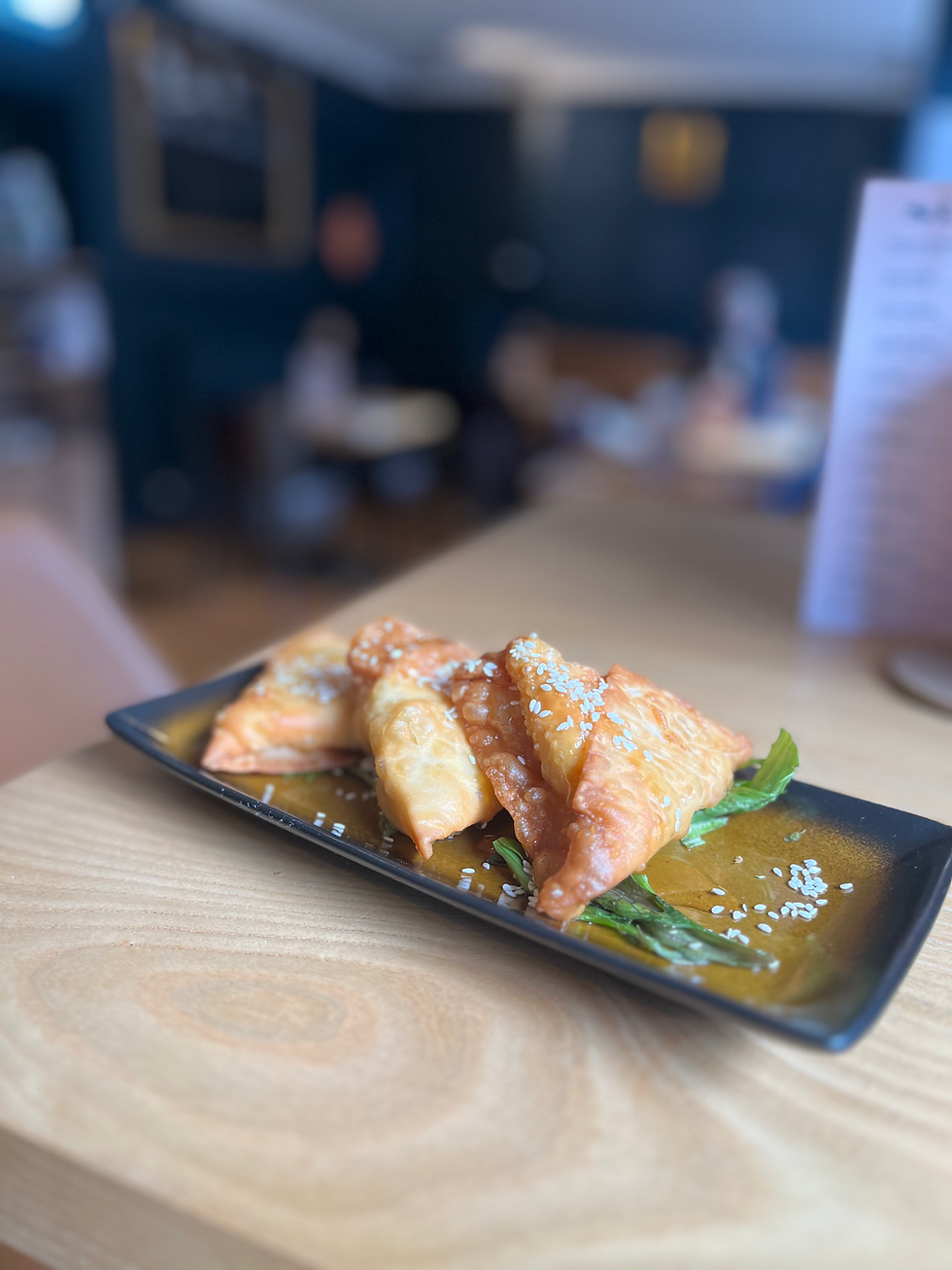
Cheese Filo Pastry. Sweet. Savoury. Crispy.

Updated: Apr 23
We have been open for almost a year now. In that time I have had the opportunity to eat this dish every single day. And I am still not bored of it.
That says something. When you are surrounded by food constantly, familiarity tends to flatten things. Dishes you loved in the first month start to feel like furniture. You stop tasting them properly and start seeing them as items on a list. The cheese filo pastry has never done that to me. Every time it comes out of the kitchen I still want a piece of it.
I recommend it to every table. Not as a rote suggestion, not as a scripted upsell, but because I have watched enough people try it for the first time to know what is going to happen. There is a particular moment, usually about two seconds after the first bite, where someone at the table looks up and says something. Sometimes it is a full sentence. Sometimes it is just a noise. But it is always the same expression.
This is a dish that does that to people. Let me explain why.
What filo pastry actually is
Filo, sometimes spelled phyllo from the Greek word for leaf, is one of the defining ingredients of Greek and eastern Mediterranean cooking. It is a paper-thin unleavened dough, rolled or stretched to near-translucency, and it appears across the full range of the Greek kitchen: in spanakopita, the classic spinach and cheese pie; in baklava, layered with nuts and soaked in syrup; in tiropita, the cheese-filled pastry that is the direct ancestor of what we serve at Nectar.
What makes filo so distinctive is its behaviour under heat. Because the sheets are so thin, the water in the dough evaporates almost instantly when it meets hot oil or a hot oven, and the result is a texture that is uniquely light and shattering: a crust that gives way immediately without any resistance or heaviness. Unlike shortcrust pastry, which has density and richness of its own, filo is essentially just structure and air. It exists to create texture and to hold things together, not to add weight.
This is why filo works so well with rich fillings. The contrast between the shattering lightness of the pastry and whatever is inside is the whole point. And there are few fillings that play into that contrast better than feta.
What happens to feta when it melts
Feta is a Greek cheese with Protected Designation of Origin status, which means that real feta must come from specific regions of Greece, predominantly mainland Greece and Lesbos, and must be made from sheep's milk or a mixture of sheep's and goat's milk. It is one of the oldest cheeses in the world, with written references going back over two thousand years, and it has been central to Greek cooking for as long as Greek cooking has existed.
Fresh feta is sharp, salty, and crumbly. It has a directness to it that some people find too forward on its own. I will be honest about this: eaten cold and straight, feta is not the cheese I would reach for first. It is an ingredient that needs context. It needs to be part of something.
What happens when feta meets heat is remarkable and is what makes this dish work. The fat content in the cheese, which is significant, causes it to soften and loosen rather than string or seize the way other cheeses might. It does not melt into a liquid pool. Instead it becomes smooth and almost creamy, the sharp edges of its flavour rounding into something considerably more mellow, and the texture transforms from crumbly and dry into something yielding and rich.
The combination of that melted, creamy interior with the crisp, shattering filo exterior is where the dish lives. Two textures, two temperatures when it first arrives at the table, and a flavour that is simultaneously familiar and completely unexpected if you have never had feta prepared this way before.
The honey and the sesame
The dish does not stop at pastry and cheese. The finishing layer of honey and sesame seeds is not a garnish. It is doing real work.
Honey has been used in Greek cooking since antiquity, and the pairing of honey with salty cheese is one of the oldest flavour combinations in the Mediterranean kitchen. There is archaeological evidence of honey production in Greece going back over four thousand years, and the combination of something intensely sweet with something intensely salty appears throughout Greek food in a way that feels completely natural rather than deliberate. It is a combination that the culture absorbed rather than invented.
The honey we use sits over the top of the warm pastry and does two things simultaneously. It cuts through the saltiness of the feta, softening the overall flavour and creating a sweetness that makes the dish feel indulgent without being heavy. And it adds a slight stickiness to the exterior of the pastry that changes the textural experience: the crunch is still there, but it is followed by something smooth and slow.
The sesame seeds add a third dimension. Toasted sesame has a nutty warmth to it that does not compete with either the cheese or the honey, but instead sits underneath both and adds depth. It also adds a visual detail and a slight additional texture that makes each piece feel considered rather than simple.
Sweet and savoury working together is one of the things Greek food does better than almost any other culinary tradition. This dish is a very clean example of that principle in practice.
Why I recommend it to every table
Part of the reason I recommend this dish so consistently is the versatility, which is rarer than it sounds. Most dishes have a natural position on the table: starter, main, side, dessert. The cheese filo pastry resists that categorisation entirely.
It works as a starter while people settle in and look at the menu. It works as a side dish running alongside a larger spread. It works as the thing you add to a platter to make sure the table has enough food. It works as a dessert, the honey making it feel like a natural close to a meal in a way that savoury food rarely manages. And it works as a nibble alongside drinks, particularly when people are not quite ready to commit to a full order.
Three pieces come on the plate, which makes it naturally shareable between two without either person having to do arithmetic about fairness. It is the right portion size: enough to be satisfying, not so much that it competes with everything else on the table.
When someone is ordering one of our platters to share between two people and they want to make sure they have enough food without over-ordering, this is the dish I point to every single time. It fills the gap without filling the table, if that makes sense. It adds to the meal without changing the character of it.
After nearly a year of recommending it, I have yet to have anyone come back and say it was the wrong call.
Where it sits on the menu
The cheese filo pastry is listed among the smaller plates on our menu, which makes it one of the most flexible things you can order. It does not demand a particular position in the meal the way a platter or a main protein does. It fits wherever you need it to fit.
If you are building a sharing table and not sure where to start, the cheese filo pastry alongside the grilled halloumi covers the best of what the kitchen does at the smaller plate end of the menu. Both dishes demonstrate Margarita's approach to Greek cooking: not overcomplicating things, trusting the ingredients, and understanding that the most memorable food is often the simplest idea executed with real care.

A wine pairing worth considering
The conventional wisdom with feta and pastry is to reach for a white wine, something crisp and acidic that cuts through the richness. And that logic is sound. But one of my favourite pairings with this dish is the Wide River Shiraz from Robertson in South Africa's Western Cape, and it is worth explaining why it works, because it is not the obvious choice.
Shiraz has generous dark fruit character and enough body to stand alongside rich, salty food without getting lost. The fruit notes in the wine, which lean toward ripe plum and blackberry, play directly against the honey on the pastry in a way that creates a conversation between the glass and the plate. The saltiness of the feta amplifies the fruit in the wine, making it taste more generous than it would alongside something neutral. And the structure of the Shiraz keeps everything balanced rather than letting the sweetness of the honey dominate.
It is the kind of pairing that teaches you something. The expected choice would reach for a white and find a comfortable match. The Wide River Shiraz finds something more interesting: a combination where both the food and the wine become more enjoyable together than either would be alone.
That is what the best pairings do.
Book a table at Nectar Bar and order the cheese filo pastry. You will not need persuading to order it again.
Opening hours Tuesday to Thursday: 5pm to 11pm Friday: 5pm to 1am Saturday: 12pm to 1am Sunday: 12pm to 11pm Monday: Closed
Nectar Bar, 73 Broughton Street, Edinburgh EH1 3RJ


