.png)
Desserts at Nectar: Three Greek Classics That Earn Their Place at the End of Every Meal

Before I tell you about the desserts, I want to tell you about the afternoon we chose them.
Shortly before Nectar opened, we spent an afternoon working through every Greek dessert we were seriously considering putting on the menu. Twelve desserts in total, tasted properly, discussed properly, argued about in the way that food decisions deserve to be argued about. Alongside them, four coffees each.
By the end of it, neither Eirini, Panos nor I were in any condition to make sensible decisions about anything. We were running on sugar and caffeine and talking very quickly about things that seemed urgent at the time and probably were not. But we had also eaten our way through twelve versions of what the Greek dessert tradition produces at its best, and by the end we knew exactly which three belonged on the table at Nectar.
The orange cake. The baklava. The chocolate cake.
The afternoon was chaotic. The choices were right.
A note on how Greek desserts work
Before getting into the three specific dishes, it is worth understanding something about how the Greek dessert tradition approaches sweetness, because it is different to most other culinary traditions and it explains why these desserts feel the way they do.
Greek desserts belong to a category called siropiasta, which translates roughly as syrup-soaked. The principle is simple and it produces something extraordinary: once a cake or pastry is baked, warm sugar syrup is poured over it and allowed to absorb fully into the structure of the dessert. The result is a moistness and a sweetness that a conventionally frosted or layered cake cannot achieve. The syrup does not sit on top of the dessert. It becomes part of it, moving through every layer and every crumb until the whole thing is permeated with a gentle, fragrant sweetness that holds together from the first bite to the last.
This technique runs through baklava, the orange cake, and elements of the chocolate cake, and it is the reason all three desserts at Nectar arrive at the table with a particular quality of moistness that is distinctive and satisfying in equal measure. A Greek dessert soaked in syrup is not a wet dessert. It is a dessert that has been completed by the syrup in a way that nothing else achieves.
The orange cake: the one people come back for
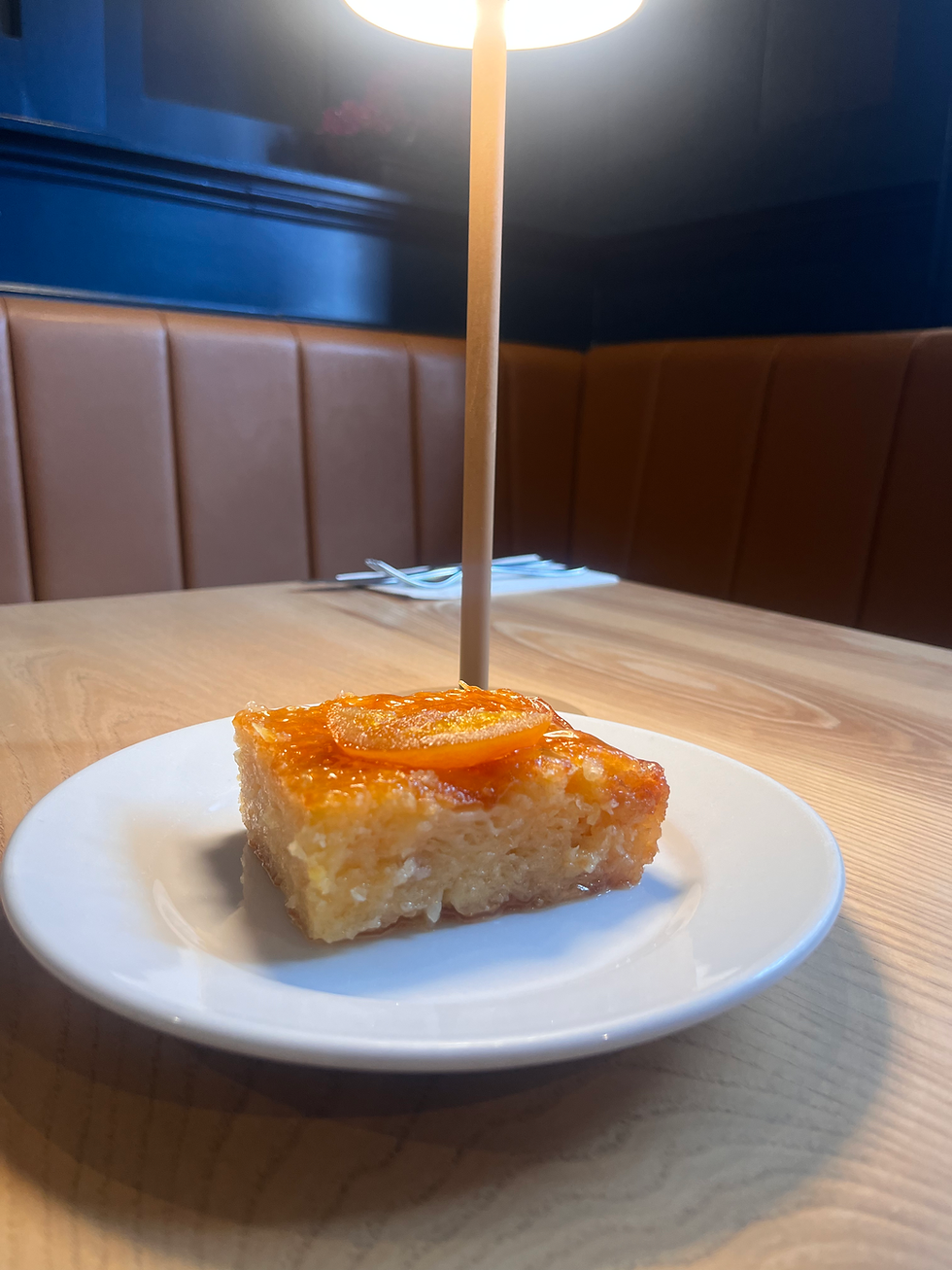
The portokalopita is our bestseller by a significant margin and has been since we opened. We have regulars who come specifically for it. People who have finished their meal, had their cocktail, and are considering leaving, who then look at the dessert menu and order the orange cake for the fourth time in as many weeks. We have had people ask whether they can take it home.
All of that says something. It says what we already know, which is that this is not a cake that needs context or explanation to work. You eat it once and you understand immediately why it keeps coming back to the table.
Portokalopita originates in Central Greece and Thessaly, the inland regions where oranges arrived as a luxury ingredient from the citrus groves of Argos and Arta from the late nineteenth century onward. They were not everyday produce in those regions. They were something that arrived by caravan and train, something festive and fragrant that the kitchen treated with the seriousness a special ingredient deserves. The cake that developed around them reflects that origin: it makes the orange the central character of everything rather than a flavouring note in something else.
What makes portokalopita genuinely unusual is what it is made from. There is no flour in the traditional recipe. None. Instead, filo pastry sheets are dried out until they are completely crisp, then crumbled into the batter, which is built from eggs, olive oil, Greek yogurt, orange juice, and orange zest. The dried filo absorbs the batter and the syrup in a way that flour never could, creating a texture that sits somewhere between a dense cake and a bread pudding: yielding, moist all the way through, with a slightly layered quality from the pastry fragments that gives each bite more interest than a standard sponge provides.
The syrup is poured over the cake while it is still warm from the oven, made from water, sugar, orange juice, orange peel, and a cinnamon stick. It soaks in completely, which is why the cake develops its characteristic moistness and why it actually improves as it rests. The version you eat at Nectar has been properly soaked, properly rested, and properly considered. The orange flavour is forward and genuine, the cinnamon is present but quiet, and the texture is exactly what it should be.
We serve the orange cake on its own or with a scoop of vanilla ice cream on top. The ice cream is the right call if you want to extend the dessert into something slightly more substantial, because the contrast between the warm, syrup-soaked cake and the cold, clean ice cream is one of those simple pairings that earns its existence every time. Both versions are worth ordering. The one with ice cream is the one I lean toward.
It is worth noting that portokalopita is traditionally served in Greek restaurants as a complimentary dessert for guests, a gesture of hospitality at the end of a meal. We charge for it, but the spirit of the thing is the same.
The baklava: three thousand years of history in a single piece

Baklava is one of the most historically contested foods in the world. Greeks and Turks have argued about who invented it for as long as either culture can remember, and the honest answer is that neither of them invented it alone. The earliest versions of layered pastry with nuts and honey appear in Assyrian records from around the eighth century BC, centuries before the Ottoman Empire that most people associate with baklava's origins existed. The Ottoman imperial kitchens at Topkapi Palace in Istanbul refined the technique in the fifteenth century, mastering the rolling of filo into paper-thin sheets that allowed for the dozens of delicate layers that define the dessert. From there, baklava spread across every culture touched by the Ottoman world, from North Africa to the Balkans, and each tradition made it its own.
The Greek version is distinct from the Turkish version in specific ways. Where Turkish baklava typically uses pistachios and a lighter sugar syrup, Greek baklava uses walnuts and a heavier honey-based syrup with cinnamon and cloves. The filo layers in the Greek tradition are slightly thicker and more present, and the overall flavour is warmer and more aromatic: the honey and the spice bringing depth that the cleaner, pistachio-forward Turkish version does not chase.
In Greek Orthodox tradition, some baklava recipes use 33 layers of filo to represent the years of Christ's life, which gives the dessert a symbolic weight in religious celebrations that most people eating it in a restaurant context never think about. But the knowledge is worth having: baklava has never been everyday food in its fullest expression. It has always been celebratory food, the thing you make when something matters.
At Nectar, the baklava arrives in the traditional format: layered, syrup-soaked, rich with honey and nuts, with the slight crispness on the outside giving way to something yielding and fragrant inside. It is a dessert that rewards being eaten slowly. The sweetness builds rather than arriving all at once, and the honey and nut combination has a depth that the description of the ingredients alone does not convey.
The chocolate cake: the one to share
The chocolate cake is the most straightforward dessert on the menu in terms of description and the most reliably correct recommendation for a table that has been eating a lot of savoury food and wants something that goes in a completely different direction.
My honest recommendation, always, is to share it between two. Not because the portion is overwhelming, but because it is a dense, rich cake that delivers its full pleasure in the first few bites and benefits from being shared across a table where the conversation is still going rather than eaten by one person in isolation. It is the kind of dessert that suits the moment when the meal is winding down but nobody actually wants to leave.
Like the orange cake, it sits in syrup and arrives with the moisture and the gentle sweetness that the Greek dessert tradition produces across every category. The chocolate is present and genuine, and the density of the cake means the flavour has a length and a persistence that a lighter sponge-based dessert would not produce.
If your table is in the mood for something rich after a lighter spread of sharing plates, this is the right call. If you have had the meat platter and several cocktails and you are looking for a dessert that does not add significantly to the weight of the meal, the orange cake is the better choice. Both answers are correct depending on where the evening has gone.
How to end the meal at Nectar
The dessert menu at Nectar is deliberately short. Three choices, chosen from twelve after an afternoon that left us both slightly spinning. The shortness is the point.
A long dessert menu is a menu that has not been edited properly. Every dish on it should be there because it is genuinely excellent in its own right and because it adds something to the range that the others do not. The orange cake is light and fragrant and has earned its position as the thing people come back for. The baklava carries the weight of a dessert tradition that goes back further than most cuisines that exist today. The chocolate cake is the indulgent option that the table deserves when the evening has been long and good.
Sometimes the right way to end a meal is simply to order all three and share them across the table. The Greek tradition of siropiasta, of desserts that have been completed by their syrup and improved by the time they sit, makes them naturally suited to a shared table rather than to individual consumption. One of each, four spoons, the conversation continuing while the plates make their way around: that is the Nectar dessert experience done properly.
If you want to pair a dessert with a drink, the Lemon Cheescake is the cocktail that sits most naturally alongside all three: it is a desert cocktail, yet does not compete with the dessert the way a spirit-forward cocktail would. For the orange cake specifically, the Assyrtiko Sauvignon Blanc is a wine pairing worth considering: the acidity of the Assyrtiko cuts through the sweetness of the syrup and the citrus in both the wine and the cake echo each other in a way that is very Greek and very right.
Book a table at Nectar Bar and leave room for the orange cake. You will not regret it.
Opening hours Tuesday to Thursday: 5pm to 11pm Friday: 5pm to 1am Saturday: 12pm to 1am Sunday: 12pm to 11pm Monday: Closed
Nectar Bar, 73 Broughton Street, Edinburgh EH1 3RJ