.png)
The Florist: The Herbal Cocktail Built From an Edinburgh Garden in a Glass

There are cocktails on the Nectar menu that announce their complexity before you taste them. The Tzatziki Martini arrives looking like water and tastes like a Greek kitchen. The Local Connection arrives looking milky and tastes like a very serious cocktail. Both do the thing where the visual information and the flavour information take a moment to reconcile.
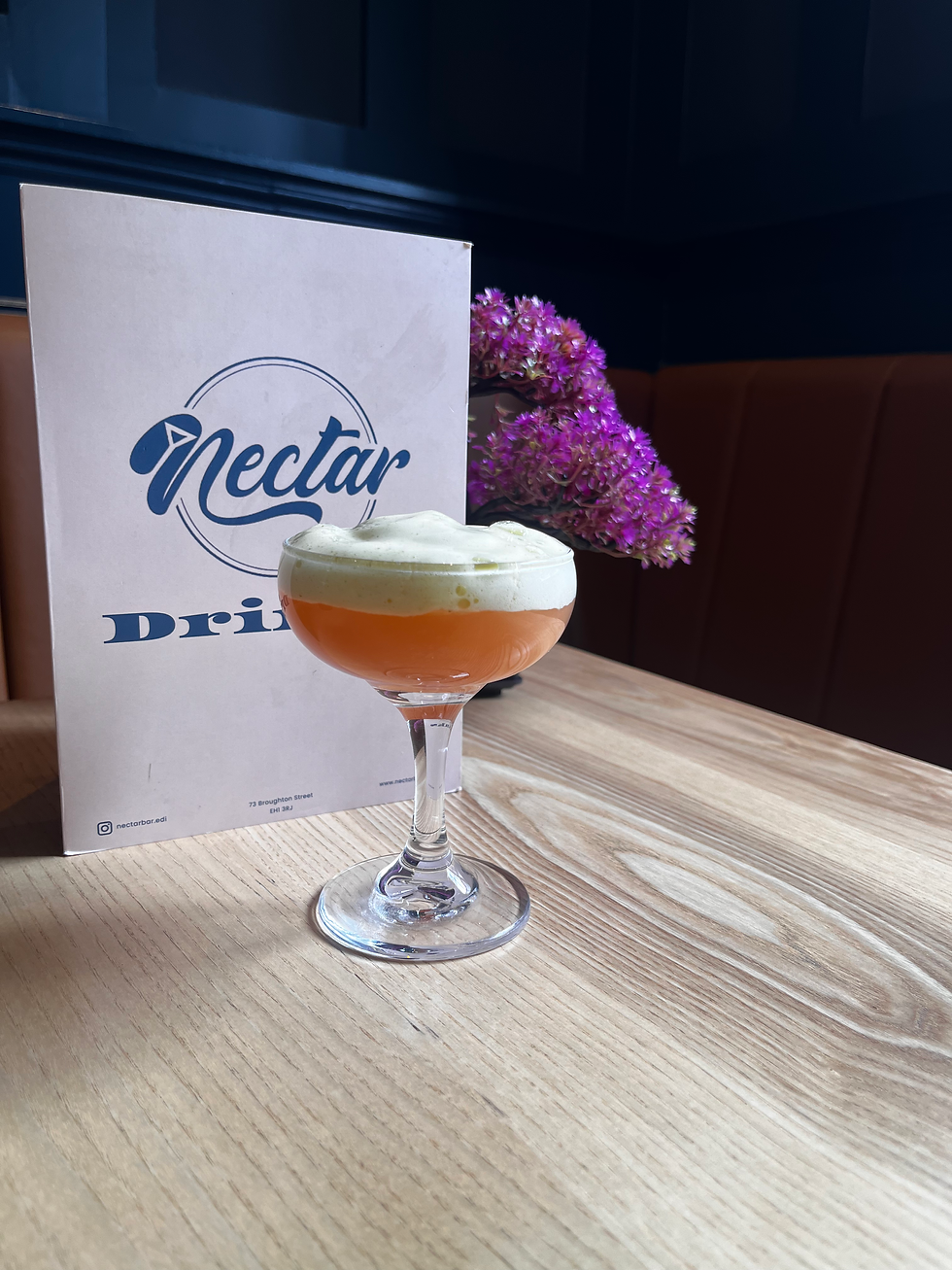
The Florist does something different. It announces everything immediately. It arrives with a foam sitting across the top of the glass that is genuinely, visibly green, herbal in colour and herbal in character, and the whole drink smells of a garden before you have touched it. There is no gap between what it looks like and what it tastes like. The visual and the flavour are telling the same story from the first moment, which is unusual at Nectar and entirely intentional.
It is described on the menu as herbaceous, green, and easy, and all three of those words are accurate. But easy is the one worth unpacking, because a cocktail that is easy to drink is not the same as a cocktail that is easy to make, and the Florist is emphatically the former rather than the latter.
Why herbal cocktails matter
The Florist came from a specific intention: to bring herbal cocktails back to the menu in a form that was genuinely layered rather than simply green-tasting.
Herbal cocktails occupy a category that is easy to get wrong. The most common version involves a single herb, muddled or infused into a spirit, producing something that tastes one-dimensionally of that herb and nothing else. Mint is the most common example: fresh, pleasant, immediately identifiable, and essentially complete as a flavour after the first sip. There is nowhere for it to go.
What makes a genuinely excellent herbal cocktail is the same thing that makes a genuinely excellent garden: multiplicity. Multiple plants in the same space, each contributing something different, creating a combined atmosphere that is more complex and more interesting than any of them would produce individually. The smell of a garden on a warm morning is not the smell of a single herb. It is the accumulated character of many things growing together, and each element influences how you perceive every other element around it.
The Florist is built on that principle. The herbs are plural, the citrus is unconventional, the floral element comes from a liqueur with centuries of Italian tradition behind it, and the foam is the moment where everything is lifted into a single, cohesive experience. Nothing in this cocktail is performing alone.
Italicus: the liqueur that changed the direction of the drink
Italicus Rosolio di Bergamotto is a bergamot liqueur created by Italian bartender Giuseppe Gallo using a generations-old family recipe, built on Calabrian bergamot oranges, Sicilian citrons, Roman chamomile, lavender, yellow roses, lemon balm, and gentian.
Rosolio itself is one of the oldest styles of Italian liqueur, traditionally offered to guests as a sign of good luck, which makes it, in a quiet way, exactly the kind of spirit that belongs in a bar built on Mediterranean hospitality. When Italicus launched in 2016 it won the best new spirit or cocktail ingredient category at Tales of the Cocktail in New Orleans, which is the most credible international spirits competition in the world, and the award reflected what bartenders around the world discovered as soon as they started working with it: Italicus is one of those ingredients that makes other things taste better rather than simply adding its own flavour on top of them.
The flavour is bergamot-forward, which is the citrus most people know from Earl Grey tea, combined with the floral complexity of chamomile, lavender, and rose, and a herbal bitterness from the gentian that stops it from being sweet in a one-dimensional way. The result is a liqueur that sits at the intersection of sharp citrus and genuine sweetness, with a floral depth that pulls both registers together.
Paired with tequila, the combination is more natural than it first sounds. El Jimador Bianco has a clean, bright agave character with an inherent citrus quality that has an affinity with the bergamot in Italicus. The sharpness of the tequila and the floral sweetness of the liqueur are not fighting each other. They are doing versions of the same thing in adjacent registers, and the result is a base that is already multidimensional before anything else is added.
Reversing the citrus
Most cocktails that include citrus reach for lime or lemon without much deliberation. Both are acidic, both are familiar, and both have an established relationship with spirits that makes them easy to incorporate without introducing anything unexpected.
The Florist uses grapefruit instead, and the decision is deliberate in a way that changes the character of the whole drink.
Grapefruit citrus is different to lime or lemon in one specific and important way: it carries bitterness alongside its acidity, rather than acidity alone. Where lime is sharp and clean, grapefruit is sharp and slightly complex, with a gentle bitterness that lingers into the finish rather than resolving immediately. In the context of a cocktail that already contains the gentian bitterness of Italicus and the botanical depth of tequila, that additional layer of grapefruit bitterness does not add more of the same thing. It extends and enriches what is already there, providing a bitter thread that runs through the whole cocktail from the first sip to the last.
The grapefruit also changes the visual register of the drink. Lime-forward cocktails tend to read as clean and precise. Grapefruit cocktails carry a different quality: slightly more complex in their acidity, slightly more generous in their citrus character, and more willing to sit alongside something as layered as the Italicus and the jasmine syrup without being overwhelmed by either.
Jasmine syrup: the element that lifts everything
A cocktail built from tequila, Italicus, and grapefruit is already an interesting drink. The jasmine syrup is what turns it into the Florist.
Jasmine sits in a specific flavour register that no other flower quite occupies: floral in a way that is more delicate than rose, more complex than elderflower, and more aromatic than anything synthetic claiming to represent it. It is the floral note that most closely resembles the experience of actually standing in a garden where something is flowering, because jasmine's aromatic character is both sweet and slightly green, both obviously floral and subtly herbal.
In the Florist, the jasmine syrup does two things simultaneously. It provides the sweetness that balances the bitterness of the grapefruit and the gentian in the Italicus, so the drink has a rounded, integrated character rather than a sharp, acidic one. And it lifts the herbal elements of the cocktail into a floral register, connecting the basil and mint foam above to the tequila and Italicus below, so the whole drink is perceived as a single herbaceous and floral experience rather than a collection of separate elements.
This is the piece that most required thought during the development of the cocktail. Finding a sweetener that did not simply add sugar but added a flavour that made every other ingredient taste more like itself is harder than it sounds. Jasmine syrup is that ingredient in the Florist, and without it the cocktail is different enough to be worth calling something else.
The foam and why it became a competition entry

The basil and mint foam is the element that most guests notice first and the element that took the longest to perfect.
Foam in cocktails is a technique that exists across many bars and produces results of varying quality. Done poorly, it produces a thin, dissipating layer of textured liquid that tastes of whatever was used to create it and collapses before the drink can be properly consumed. Done well, it produces something that is structurally stable, flavourful enough to be genuinely present in every sip, and visually striking in a way that is honestly earned rather than cosmetically applied.
Panos spent considerable time developing a basil and mint foam that behaved the way it needed to behave: stable across the time it takes to consume the cocktail, green and genuinely herbal in flavour rather than faintly coloured and vaguely botanical, and present enough in the mouth to be tasted distinctly from the liquid beneath it while harmonising with everything in the glass.
The foam is experienced in two stages with every sip. First, the herbs: basil's slightly peppery, faintly sweet herbal character followed immediately by mint's clean, cooling quality. Then the cocktail below it, tequila and Italicus and grapefruit and jasmine, which arrives alongside the fading herbal character of the foam in a way that makes the two elements feel like different moments in the same story rather than separate ingredients sharing a glass.
The quality of that foam is what led it beyond the Florist itself. When Panos entered the Jägermeister Meister Hunter competition, the annual cocktail competition that invites bartenders to create an original cocktail that genuinely works with Jägermeister's intensely herbal character, the foam became the central technique. Jägermeister is built from 56 herbs and botanicals: the challenge of the competition is not simply to make a cocktail that contains it, but to make one where its complexity is enhanced rather than hidden. Panos's instinct was that more herbs, rather than fewer, was the right approach. A foam carrying its own herbal complexity, layered over a spirit already dense with botanical depth, amplifies what is in the glass rather than trying to moderate it. The entry was named The Still Hour, and the foam that began in the Florist was at the centre of it.
What the Florist tastes like
Herbaceous, green, and easy. The menu's description is honest.
The first thing you encounter is the foam: basil and mint together, fresh and present, lifting the whole drink into a register that is immediately recognisable and immediately appealing. Then the grapefruit citrus of the liquid below it, sharp and slightly bitter. Then the Italicus, floral and complex, bergamot and chamomile and lavender coming through in sequence rather than all at once. Then the tequila, giving the drink its backbone and its length. And underneath everything, the jasmine, present as a sweetness and a floral continuity that ties the garden metaphor together from start to finish.
It is easy in the sense that it does not ask much of you. It is complex in the sense that it rewards attention if you want to give it. Both of those things are true of the best cocktails, and the Florist is genuinely one of the best things currently on the Nectar menu for someone who wants something that is visually extraordinary, immediately approachable, and considerably more layered than its accessibility suggests.
It is also, on the right evening, the right beginning. The Laterna is the lightest opening. The Florist is the most aromatic one. Both say something specific about the evening ahead, and which one is right depends entirely on what kind of night you are planning.
Book a table at Nectar Bar and order the Florist first. The foam is worth seeing arrive.
Tuesday to Thursday: 5pm to 11pm Friday: 5pm to 1am Saturday: 12pm to 1am Sunday: 12pm to 11pm Monday: Closed


