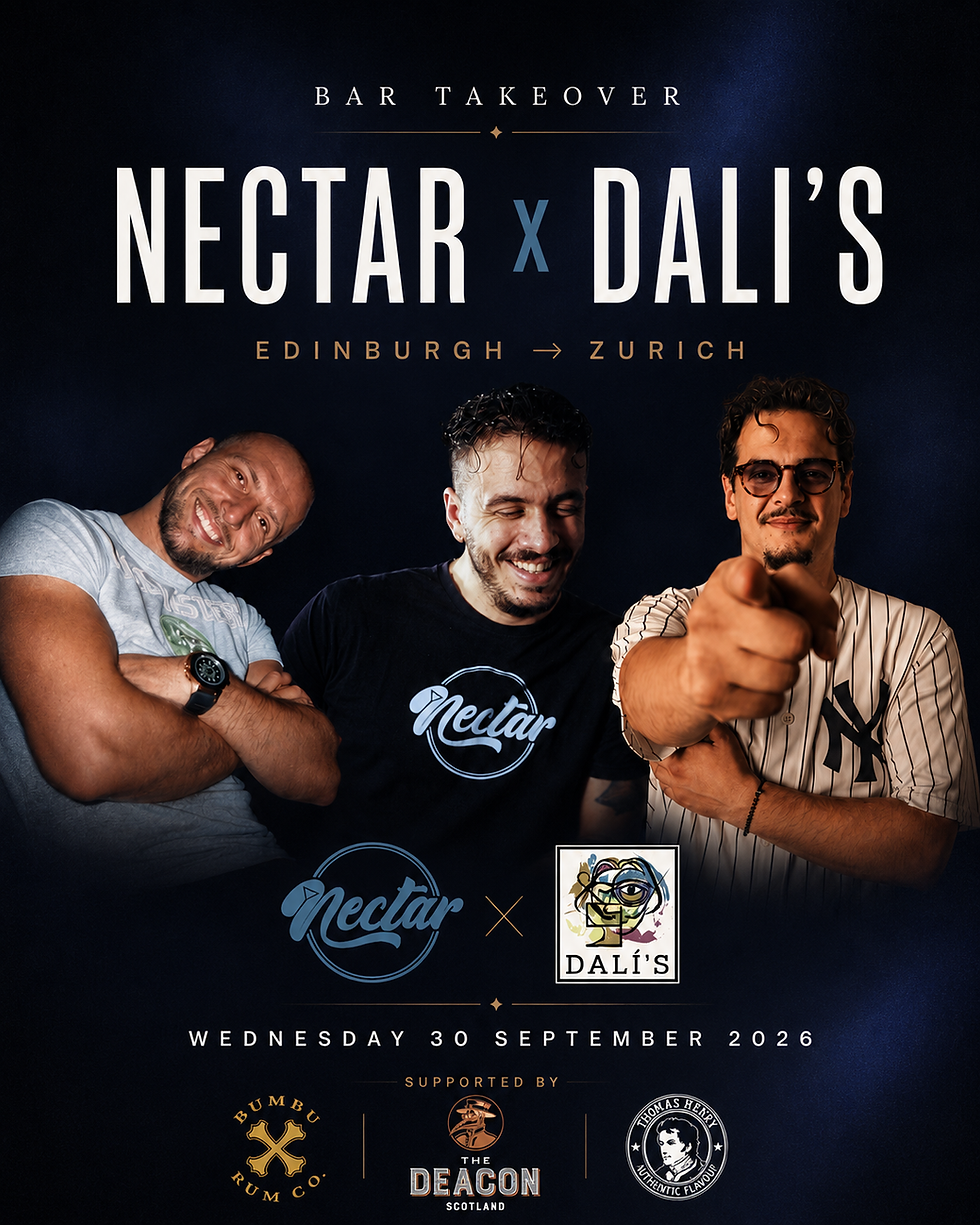
What Is a Bar Takeover? How They Work, Who Oragnises and What It Is Really Like Behind the Bar

A bar takeover is when a bar team visits another bar and runs the night there. The visiting bartenders bring their own drinks, usually in place of the host's regular menu, and the host bar gives them the room, the guests and the glassware. Everybody gets something out of it. The host gets a new reason for guests to come through the door, the visitors get a new audience, and guests get a night they could not have had anywhere else.
That is the short answer. The longer one is more interesting, because I have just done my first one, and it is not quite what I imagined from the outside.
In September, Panos and I took Nectar to Zurich and took over Dalí's Bar for a night. I have told the story in two parts: why we did it, and what the night was actually like. This article is the explainer I wish I had read first. It covers how takeovers work, who pays, why bars do them, and where they go wrong.

Bar takeover, guest shift and pop up: what is the difference?
People use "bar takeover" and "guest shift" almost interchangeably. Punch describes guest shifts, also called bar takeovers, as the same thing. In both cases, a visiting team temporarily runs a host bar.
A pop up is a different animal. With a pop up, you bring a bar to a space that does not have one, such as a private party or an event. Nectar did exactly that for the first time recently, and I wrote about it in Our First Cocktail Pop Up in Edinburgh. The difference is that in a pop up, the room belongs to nobody. In a takeover, the room belongs to somebody, with its own team, its own regulars, its own identity and its own standards. You are a guest in it.
That difference changes how you behave. At a pop up, you are building a bar. At a takeover, you are visiting one.
How a bar takeover works, from first message to last glass
Every takeover is a little different, but most follow the same shape.
The agreement. It starts with a conversation between two bars, and ours started with a friendship. Class Magazine describes a guest shift as a collaborative event where one bar's team takes over another venue to deliver a fresh experience, typically through industry friendships. You settle a date, you agree what the night is for, and you decide who is responsible for what.
The drinks. The visiting team builds a short list of cocktails for the night. In our case, none of them were on the Nectar menu. Every drink was created specifically for Zurich, and every drink was limited. When a drink runs out, the bar moves from takeover back to the host's regular service.
The partners. Spirit and mixer brands often support takeovers. Punch notes that brands frequently sponsor them, using the event to promote their products while the bartenders gain exposure to new audiences. Our night was backed by Bumbu Rum, The Deacon Whisky and Thomas Henry mixers.
The prep. This is the part guests never see. Complicated ingredients such as cordials, infusions and tomato water are prepared the night before, so the day of the event is only about setting up and serving. We did exactly that in Zurich.
The setup. On the day, the visiting team arrives, builds its prep stations, walks through the process with the host team and, if you are doing it properly, sits down to eat together. Ours was pizza from across the road.
The service. Guests arrive, the menu is different from usual, and the night begins. This is the part that looks effortless when it is done well.
The close. The team cleans, the host bar returns to normal, and, in our case, everyone went out for a drink.

Why bars do takeovers at all
Because everyone in the room gets something different out of it.
For the host bar, a takeover gives regulars a reason to come on a night they might otherwise have stayed in, and a reason for new guests to find the bar. It also gives the host team a chance to see how other people work.
For the visiting bar, it is a way to meet a new audience on someone else's ground. You cannot buy that with an advert. You earn it by pouring good drinks to people who did not come for you.
For brands, it is a chance to put their product into the hands of guests in a setting that carries some weight.
For guests, it is a night out with a different menu, a different team and a different story, without needing a plane ticket. Or, in the case of Zurich, with a plane ticket on our side.
For the bartenders, it is a very particular kind of education. You see how another bar thinks, how another team moves, and which of your ideas travel.
What it feels like behind the bar
Here is the honest version from our night.
The regular menu is not available, so guests have to be comfortable with the new drinks. Ours were super funky, and sometimes people were not willing to try them. That is a fair reaction. You walk into a bar you know and someone offers you a beetroot and coriander rum drink. A big part of the job is making the unusual sound safe without making it sound dull.
Another surprise was how much it matters who is in the room. I knew most of the guests, so they wanted to spend time with me, which is a blessing and a curse at once. I imagine most takeovers do not work like that, or at least not on that scale. A visiting bartender usually arrives as a stranger and has to earn the room. I arrived as a local who had been away.
And then there was the brand support. The Bumbu representative travelled up from Lausanne and spent the night walking the room, serving drinks and explaining the history of the spirit to guests who were already holding a Bumbu drink. That is what good brand involvement looks like. It is a person telling a story at the right moment, not a banner.

Where bar takeovers go wrong
It would be dishonest to write about takeovers without saying that they can be bad. Industry writers have been saying so for a while.
Too many of them. Punch reported that Bangkok had seen up to fifteen guest shifts in a single week, and quoted a hospitality director warning that nightly guest shifts stretch the industry thin. When every night is a special night, none of them is.
Guests who came for something else. People sometimes travel to a bar for its signature cocktails and find a takeover menu instead. Punch flags that as a real source of disappointment. This is why hosts need to tell guests clearly in advance what is happening, and why a good takeover has an answer for the person who just wants their usual.
Transactional events. Class Magazine puts it well: the priority on a takeover should be the guest's experience, not just promoting the bars and brands involved. The ones that fall flat feel like a marketing exercise, with a team going through the motions.
No clear purpose. One bar manager quoted by Punch says the question to ask is what specific value the exchange will create. I think that is the best test there is. If you cannot answer it in a sentence, do not do the event.
How to tell a good bar takeover from a gimmick
If you are a guest, a few things are worth looking for.
First, a real reason. The best ones have a story behind them, whether it is a friendship, a shared ingredient or a city connection. Ours had an obvious one, and it made everything easier.
Second, drinks that were made for the night. A takeover that simply re-serves the visitor's regular menu is a transplant. One built around new drinks is an event.
Third, a host who looks proud, not tired. When the home team clearly wants the night to work, you can feel it in the room.
Fourth, brands that show up as people. If a representative is talking to guests, you are probably at something thoughtful.

If you are planning your first takeover
From our night, this is what I would pass on.
Prepare the complicated ingredients the day before, so the day itself is about service. Keep the drinks limited and say so in advance. Put the team through a family meal before the doors open, because it turns two teams into one. Ask your brand partners to show up in person. Expect some guests to be reluctant, and plan how you will explain your drinks to them. And remember that you are a guest in someone else's bar, so the host's standards come first.
If you are the host, show the visiting team's work authentically, promote the night properly to your regulars and give the visitors clear information well before the date. Class Magazine's advice to hosts is to promote the event, communicate clearly and stay hospitable, and it holds up.
Bar takeover questions people ask
How long does a bar takeover last? Usually one evening. Ours was one night at Dalí's in Zurich.
Can I still order from the regular menu? Usually not. The takeover menu replaces it, and when a takeover drink runs out the bar goes back to normal service. Check with the host bar before you go, especially if you are coming for something specific.
Do I need to book? It depends on the bar, but the busy ones fill up. If a bar is promoting a takeover, check its website or social channels for booking details.
Is a bar takeover the same as a pop up? No. A takeover happens in an existing bar with its own team and regulars. A pop up brings a bar to a space that does not have one.
See what a Nectar night feels like
A takeover is a one night version of what we try to do every week on Broughton Street: good drinks, a team that cares, and a room people want to stay in. If you would like to see that for yourself, book a table at Nectar Bar and ask the team what we brought back from Zurich. For anything more private, our events page has the details.
Tuesday to Thursday: 5pm to 11pm Friday: 5pm to 1am Saturday: 12pm to 1am Sunday: 5pm to 11pm Monday: Closed